■ We are looking forward to People who are interested in Affective engineering!!
Here, we introduce the flow of activities from the third-year course “Information Management Project Seminar,” where students are assigned to a seminar/laboratory,
to the fourth-year “Graduation Research,” and further to research activities in graduate school.
These courses account for about half of the four years of university life. Let us take a look, step by step,
at what these courses involve and what students will do after joining our seminar/laboratory.
Q: What fields of technology are studied in the Takenouchi Laboratory?
A: Our laboratory covers a broad range of technologies related to Kansei Engineering, system development, and other related areas.
For example, consider a system that attempts to search for or generate images that a user prefers using only information about the user’s likes and dislikes.
Developing such a system involves many different technologies. These include system development technologies such as Python and Java,
technologies related to user interfaces that allow users to input their preferences, and core technologies for image retrieval and image generation that form the foundation of the system.
Among the courses that third-year students have taken by the end of their second year (including electives), the following are especially relevant.
For third-year courses, the following are relevant.
These are just a few examples; the list could go on. Research involves a wide variety of technologies working together.
In addition, when research focuses on specific objects or domains, knowledge about those areas is also necessary. For example, in past projects involving topics such as cosmetics or music, understanding of those fields was naturally required.
Among the courses that third-year students have taken by the end of their second year (including electives), the following are especially relevant.
- Web Design: We also develop systems that run on web browsers.
- Data Structures and Algorithms: Understanding how computational processes are designed in programs is very important.
- Introduction to Programming / Programming I: Python is necessary for customizing and using generative AI.
- Programming II: Java is often used when certain functions are difficult to implement in Python.
- Kansei Engineering: This is essential, as it forms the foundation for an interest in our laboratory.
For third-year courses, the following are relevant.
- Software Development: Essential for understanding the software development process and for creating GUI applications.
- Soft Computing: This is a core technology used in the search framework of our laboratory.
- Data Visualization: How data is presented is also important in presentations.
These are just a few examples; the list could go on. Research involves a wide variety of technologies working together.
In addition, when research focuses on specific objects or domains, knowledge about those areas is also necessary. For example, in past projects involving topics such as cosmetics or music, understanding of those fields was naturally required.
Q: What do students work on in the first semester of the Information Management Project Seminar?
A: Students acquire the fundamental skills needed to engage in practical and applied activities.
During the first semester, students develop skills in programming and presentation.
Let’s develop programming skills!
In our laboratory, most undergraduate research projects focus on system development.
However, the systems developed in our laboratory are different from typical operational systems
such as attendance management systems or inventory management systems.
Instead, we aim to develop human-friendly computer systems that may be widely used in the future,
as well as systems that explore and understand human preferences.
For this type of system development, programming skills are essential.
At present, programming is necessary to make computers operate according to human intentions.
For more details, please refer to the
Programming
page.
Develop your presentation skills!
Even if you have excellent research results, plans, or ideas, they lose their value if they cannot be communicated effectively to others.
To avoid this, our seminar conducts a seminar-style reading and presentation session in which students research topics related to soft computing in advance and present their findings during class.
This is not a lecture delivered by the instructor. Instead, students take the lead by presenting to one another and deepening their understanding through discussion.
Many university laboratories use this type of seminar-style learning method.
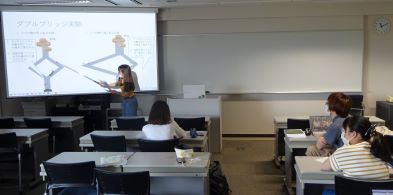
Scene of the presentation.
Scene of the presentation.
Q: What do students work on in the second semester of the Information Management Project Seminar?
A: Students engage in practical and applied activities, often referred to as a pre–graduation research project.
After completing a series of programming exercises and practical training during the first semester, students begin to consider research topics with their future graduation research in mind.
In principle, students are expected to propose their own research topics. However, in some cases, the instructor may also suggest possible topics.
In any case, the final research topic is decided with the student’s agreement.
For more details, please see the
PBL
page.
■ Grade
- 3rd Grade Activity
- Programing Excise
- Problem Based Learning
- 4th Grade Activity
- Research Presentation
- Graduate School
- Domestic Conference
- International Conference
- Event
Address
3-30-1 Wajiro-higashi,
Higashi-ku, Fukuoka
811-0295, Japan
h-takenouchi [a] fit.ac.jp
3-30-1 Wajiro-higashi,
Higashi-ku, Fukuoka
811-0295, Japan
h-takenouchi [a] fit.ac.jp