
■ Preliminary stage of graduation research!
Problem Based Learning,PBL for short.
This is a way of learning that students themselves "find something, plan yourself and work on things".
In our laboratory, PBL mainly involves basic verification for future graduation research,
system prototype development, and analysis of Kansei (affective) information as a preliminary step toward the final research project.
During the second semester, we hold regular discussions to talk about the progress made so far and plans for future work. Whether or not to adopt the ideas that come up in these discussions is ultimately up to the students themselves. In other words, regardless of what others—including the instructor—may suggest, students decide what they truly want to pursue and work toward making it a reality. People who find this kind of activity enjoyable are likely well suited for research. Not only for graduation research, but experiences like this will become a valuable asset in your future life. We encourage you to do your best.
During the second semester, we hold regular discussions to talk about the progress made so far and plans for future work. Whether or not to adopt the ideas that come up in these discussions is ultimately up to the students themselves. In other words, regardless of what others—including the instructor—may suggest, students decide what they truly want to pursue and work toward making it a reality. People who find this kind of activity enjoyable are likely well suited for research. Not only for graduation research, but experiences like this will become a valuable asset in your future life. We encourage you to do your best.
Q: What kinds of research topics have been common in recent years?
A: Many topics focus on basic verification for graduation research, often including impression analysis!
We have conducted impression analysis using the Semantic Differential (SD) method, which students learn in Kansei Engineering (an elective course in the second semester of the second year).
As a preliminary step toward graduation research, students have also analyzed eye-tracking data while viewing cosmetics or beauty magazines and developed prototype systems for image editing using onomatopoeia.
For the SD method experiments, materials such as CD jacket designs, movie promotional posters (English and Japanese versions), and J-POP songs have been used as evaluation subjects.
In addition, eye movement data were measured while participants evaluated these materials, allowing us to examine the relationship between preferred designs and visual attention.
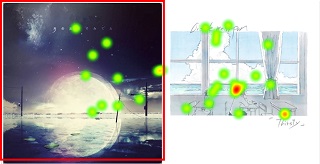
Eye-Tracking Data Analysis
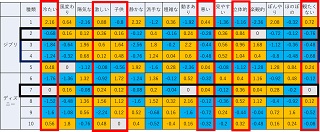
Analysis of SD method
Regardless of the specific topic, including graduation research, the final quality of the work ultimately depends on each student’s own abilities and motivation.
If the research is highly accomplished or the topic is particularly original, there may also be opportunities to present the work at academic conferences!!
Let’s build on the experience gained through PBL and connect it to your graduation research!
Examples of PBL outcomes that led to external presentations
[Conference Presentations] Masaki Kawakubo , Hiroshi Takenouchi, “Changes in Impressions of Songs Across Generations of Singers and Listeners,” Proceedings of the 27th Annual Conference of the Japan Society of Kansei Engineering, 1P01-06, Sep. 2025 (Tokyo).
[Conference Presentations] Shion Isayama , Hiroshi Takenouchi, “Measurement of Eye-Tracking Data in the Selection of Favorite Cosmetics,” Joint Symposium of the Life Software, Kansei Workshop, and Jiritsu-no-Kai, Japan Society of Kansei Engineering, A2-3, Dec. 2022 (Hiroshima).
Excellent Presentation Award!
[Conference Presentations] Airi Hattori , Hiroshi Takenouchi, “Changes in Purchase Intention Based on Impressions of Jacket Photographs,” Proceedings of the 23rd Annual Conference of the Japan Society of Kansei Engineering, 1P18-23-06, Sep. 2021 (Online).
Bold: Students from our laboratory
Let’s build on the experience gained through PBL and connect it to your graduation research!
Examples of PBL outcomes that led to external presentations
[Conference Presentations] Masaki Kawakubo , Hiroshi Takenouchi, “Changes in Impressions of Songs Across Generations of Singers and Listeners,” Proceedings of the 27th Annual Conference of the Japan Society of Kansei Engineering, 1P01-06, Sep. 2025 (Tokyo).
[Conference Presentations] Shion Isayama , Hiroshi Takenouchi, “Measurement of Eye-Tracking Data in the Selection of Favorite Cosmetics,” Joint Symposium of the Life Software, Kansei Workshop, and Jiritsu-no-Kai, Japan Society of Kansei Engineering, A2-3, Dec. 2022 (Hiroshima).
Excellent Presentation Award!
[Conference Presentations] Airi Hattori , Hiroshi Takenouchi, “Changes in Purchase Intention Based on Impressions of Jacket Photographs,” Proceedings of the 23rd Annual Conference of the Japan Society of Kansei Engineering, 1P18-23-06, Sep. 2021 (Online).
Bold: Students from our laboratory
■ Grade
- 3rd Grade Activity
- Programing Excise
- Problem Based Learning
- 4th Grade Activity
- Research Presentation
- Graduate School
- Domestic Conference
- International Conference
- Event
Address
3-30-1 Wajiro-higashi,
Higashi-ku, Fukuoka
811-0295, Japan
h-takenouchi [a] fit.ac.jp
3-30-1 Wajiro-higashi,
Higashi-ku, Fukuoka
811-0295, Japan
h-takenouchi [a] fit.ac.jp